How to Start a Cat Litter Distribution Business: A Step-by-Step Guide
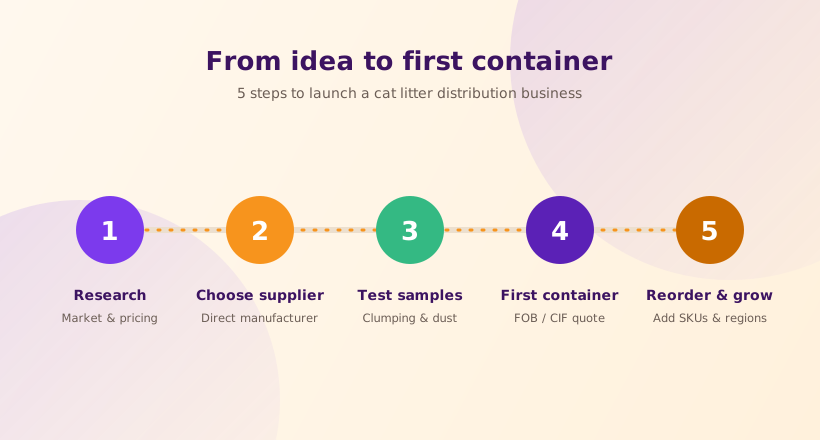
Cat litter is a repeat-purchase product: every cat household buys it again and again, which is why it makes a solid anchor product for a pet distribution business. The catch is that it is heavy, freight-sensitive and brand-loyal, so the difference between a profitable distributor and a stuck one usually comes down to decisions made before the first order. Here is a practical path from idea to first container.
In this guide
Step 1: Research your market
Before contacting any supplier, spend a week in the market you plan to sell into. Visit pet shops and supermarkets, browse online marketplaces, and note what is actually on the shelf:
- Price points. Record shelf prices per kilogram across budget, mid-range and premium brands so you know where a new product can sit.
- Litter types. Note the mix of clumping bentonite, non-clumping clay, silica and plant-based litters. A market dominated by non-clumping clay may be an opening for a quality clumping product; our clumping vs non-clumping guide covers how buyers compare them.
- Pack sizes and fragrances. Which sizes sell fastest, and are scented or unscented variants missing?
- Sales channels. Independent pet shops, supermarket chains, veterinary clinics, catteries and online marketplaces each buy differently and expect different pack sizes and terms.
The goal is a one-page picture: who you will sell to, at what shelf price, in which pack size. Every later decision hangs off it.
Step 2: Choose the right supplier
Supplier choice is the decision that is hardest to reverse. Prioritize a direct manufacturer over a trading company: you get factory-direct pricing, consistent quality and someone accountable for the product. Confirm the basics before you go further:
- Export track record and the countries already served
- Retail (5kg) and bulk (25kg) pack sizes, and available fragrances
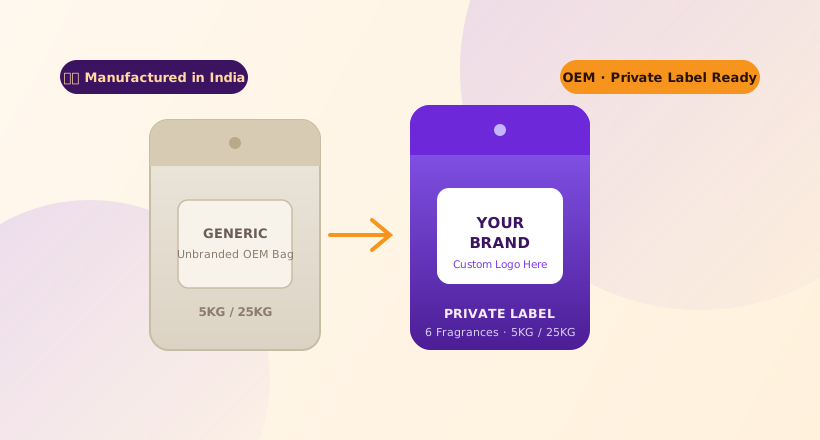
- Private label or custom branding if you want your own brand, explained in our private label guide
- Export documentation, including a Certificate of Analysis and Safety Data Sheet (VetPet Care shares both on the certificates page)
- Supply consistency for reorders, not just the first shipment
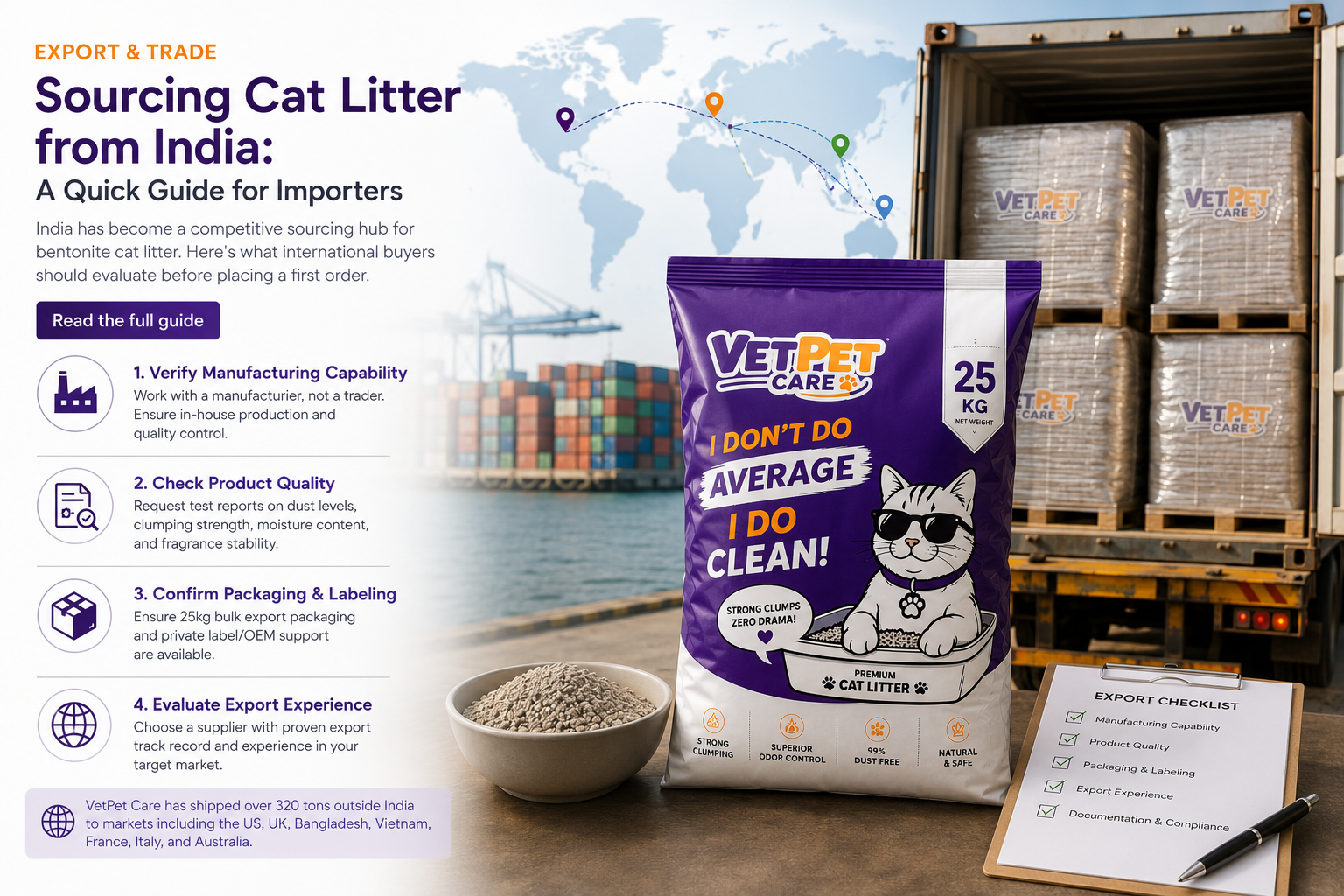
For a fuller checklist, see our guide to sourcing cat litter from India.
Step 3: Work out landed cost and margin
The supplier's price is only one line of your real cost. Build a simple per-bag landed cost so you can see your true margin before you commit:
| Cost line | Where it comes from |
|---|---|
| Supplier price (FOB) | Manufacturer quote, loaded at origin port |
| Sea freight and insurance | Freight forwarder, or included in a CIF quote |
| Import duty and taxes | Set by HS code and destination; see our HS code and duty guide |
| Port, clearance and handling | Customs broker and port charges |
| Inland transport and storage | Trucking and warehouse costs |
| = Landed cost per bag | Divide the total by bags in the container |
Then work backwards from the shelf price you found in Step 1: subtract the retailer's margin to see the price you can charge, and compare it with your landed cost. Container capacity matters here because it sets how many bags share the freight bill; our container loading guide explains why weight, not volume, is usually the limit for cat litter.
Step 4: Test samples before you commit
Never order a container on a spec sheet alone. Request samples in the fragrances you plan to sell and test them the way your customers will:
- Clumping strength. Do clumps hold together when scooped, or crumble?
- Dust. Pour a bag and watch for a cloud. Low dust is a strong selling point; see what "dust-free" really means.
- Odor control after 24 hours and after several days of use.
- Packaging. Are the bags tough enough for freight, and is the shelf presentation good?
- Real cats. Put it in a few litter boxes and see whether cats accept it.
Step 5: Place your first order and grow
Confirm in writing the MOQ, pack size mix, FOB and CIF price, production lead time, payment terms and documentation. A sensible pattern is to start with the pack size your main channel needs, prove sell-through, then reorder and widen the range: add a second fragrance or the 25kg bulk bag, or approach a new region. As volume grows, private label lets you build your own brand on the same product.
Track sell-through per outlet in your first two months. Reorder timing matters as much as the first order, because running out of stock is the fastest way to lose a shelf slot to a competitor.
Common mistakes new distributors make
- Judging by ex-factory price alone and ignoring freight, duty and clearance.
- Skipping samples and discovering a quality problem after a container has shipped.
- Ordering too many fragrances at once instead of proving one or two first.
- Ignoring documentation until the container is at port.
- Working with a trading company that cannot answer production or quality questions.
Ready to become a VetPet Care distributor?
VetPet Care is a direct manufacturer of 100% natural bentonite clumping litter, with 320+ tons shipped outside India. Share your country, target volume and pack size and we will reply with MOQ, FOB/CIF pricing and samples within 24 hours.
Request Distributor Pricing →